The AI Search Revolution
Impact on Traditional Search Engines and the Corporate Shift to Conversational Discovery
Executive Summary
The emergence of AI-powered conversational tools — ChatGPT, Perplexity, Claude, Google Gemini, and their peers — has triggered one of the most consequential disruptions in the history of information retrieval. What began as a consumer novelty in late 2022 has matured into a structural shift that is measurably eroding the dominance of traditional keyword-based search engines while simultaneously rewriting the rules of how corporations must present information to their customers.
This report addresses two interconnected questions. First, how much has AI-driven information gathering actually reduced the volume of searches executed on Google, Yahoo, and similar engines? Second, to what extent are corporations adopting AI-powered conversational search for their own customer-facing applications — and what percentage of customers are actively demanding this experience?
The findings are unambiguous: AI is not merely supplementing traditional search; it is beginning to replace it for a meaningful and growing share of information-seeking behavior. At the same time, the corporate response is accelerating rapidly, driven by compelling evidence that customers who encounter AI-powered search experiences convert at dramatically higher rates and report significantly greater satisfaction.
Part I: The Measurable Impact of AI on Traditional Search Engines
1.1 The Scale of the Shift: Raw Numbers
To understand the disruption, one must first appreciate the sheer scale of the incumbents. In 2024, Google processed more than 5 trillion searches, equating to approximately 14 billion searches per day — a figure confirmed both by Google's own public disclosures and by independent clickstream research from Datos and SparkToro. This volume represents decades of entrenched user behavior and remains, by any measure, the dominant form of digital information retrieval.
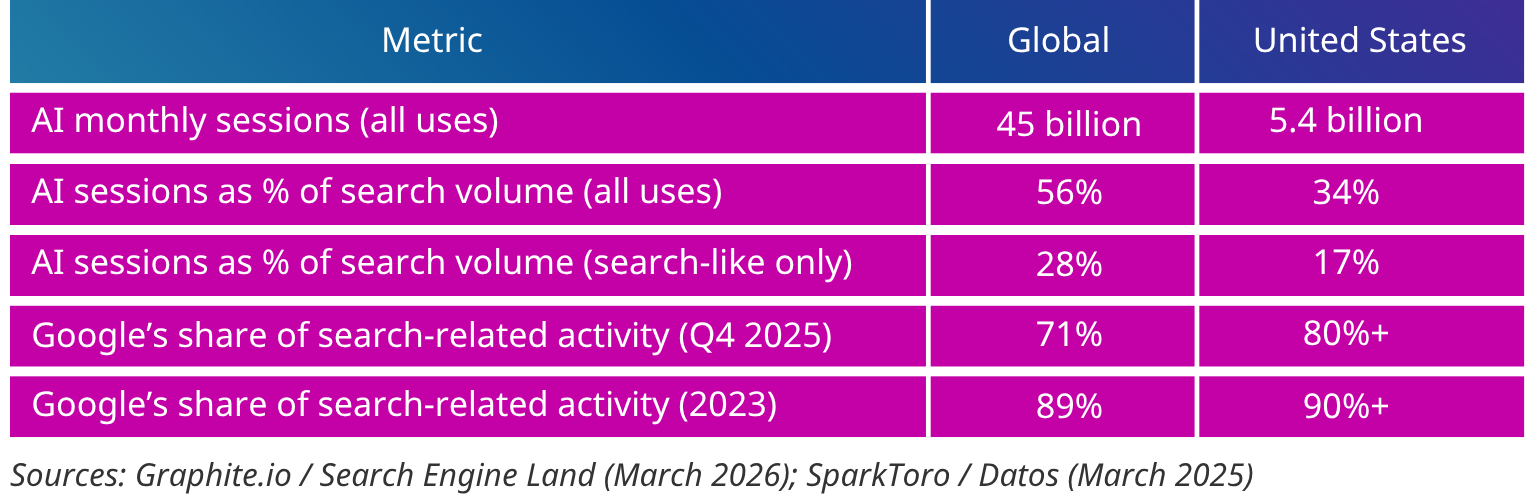
Against this backdrop, the rise of AI tools is striking in its pace, even if the absolute numbers remain comparatively modest. As of early 2026, the most comprehensive analysis of AI tool usage — a study by Graphite.io CEO Ethan Smith published in March 2026 — found that AI platforms collectively generate 45 billion monthly sessions worldwide, a figure that equals approximately 56% of global search engine volume when all platforms and mobile app usage are combined. In the United States specifically, AI accounts for 5.4 billion monthly sessions, representing approximately 34% of U.S. search volume by session count.
However, these headline figures require careful interpretation. The majority of AI interactions — roughly 52% according to OpenAI's own research — are information-seeking in nature, the closest functional equivalent to a traditional search query. When isolating only these "search-like" prompts, AI usage equals approximately 28% of search volume worldwide and 17% in the United States. The discrepancy between the 56% headline figure and the 17–28% search-equivalent figure reflects the fact that AI tools are used for a wide range of tasks beyond information retrieval, including content creation, coding, and image generation.
Table 1: AI vs. Traditional Search — Scale Comparison
1.2 Google's Declining Share — and the Nuanced Picture
The data on Google's trajectory reveals a nuanced story: Google is not losing users, but it is losing searches per user — a distinction with profound commercial implications.
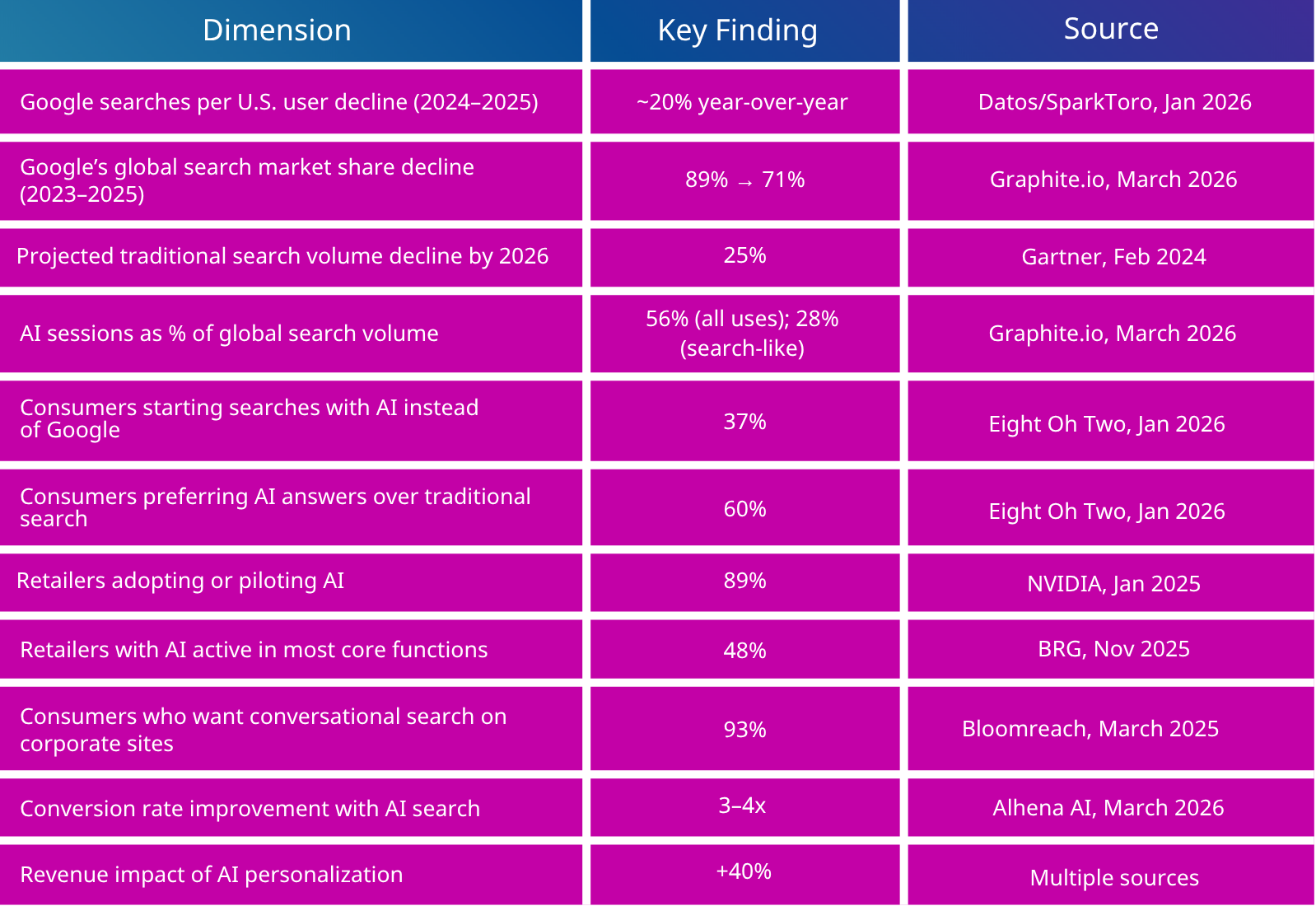
According to a January 2026 report from Datos and SparkToro based on clickstream data from tens of millions of U.S. users, Google desktop searches per user fell nearly 20% year-over-year from 2024 to 2025. This drop is concentrated in the United States, where AI adoption is most advanced; in Europe and the United Kingdom, the decline was a far more modest 2–3%. The interpretation offered by SparkToro co-founder Rand Fishkin is direct:
"The big highlight here is the decline in # of Google searches/searcher from 2024–2025. It's a nearly 20% decline in the US, though only 2–3% in the EU/UK. Other studies have shown that Google is sending less traffic than in years past, especially to the long-tail of the web, and I suspect that AI answers have dramatically altered the way many users engage with Google, answering their questions before they ever need to click on an organic result or perform a second/third/fourth search."
Separately, Semrush research found that Google's global traffic decreased 7.91% in the period following ChatGPT's widespread adoption. Meanwhile, a separate analysis found that Google's share of search-related activity fell from 89% in 2023 to 71% in Q4 2025 — an 18-percentage-point decline in market share within just two years.
It is important to note that Google's absolute search volume actually grew in 2024, rising by approximately 21.64% year-over-year according to Datos research. This growth was partly driven by Google's own AI Overviews feature, which appears to encourage users to ask more questions. However, this growth masks the structural shift: users are asking fewer follow-up questions and clicking through to far fewer external websites, because AI-generated summaries answer their needs directly on the results page.
1.3 The Zero-Click Phenomenon and Traffic Collapse
Perhaps the most consequential consequence of AI's integration into search is the dramatic rise of "zero-click" searches — queries that are answered directly on the search results page without the user visiting any external website. By 2025, approximately 60% of all Google searches ended without a click to any destination, according to research from Bain & Company and Digital Bloom.
Bain's research further found that 80% of search users now rely on AI-written summaries for at least 40% of their searches, directly reducing organic web traffic to external sites by an estimated 15–25%. For publishers ranked first in traditional search results, the impact can be catastrophic: one study found that sites previously ranked first can lose up to 79% of their traffic when their content appears below a Google AI Overview summary.
McKinsey's October 2025 analysis projected that unprepared brands may experience a decline in traffic from traditional search channels of anywhere from 20 to 50 percent as AI-powered search becomes the norm.
1.4 The Gartner Forecast and Long-Term Trajectory
In February 2024, Gartner issued one of the most widely cited predictions in this space: that by 2026, traditional search engine volume will drop 25%, with search marketing losing market share to AI chatbots and other virtual agents. Gartner's Vice President Analyst Alan Antin stated:
"Generative AI solutions are becoming substitute answer engines, replacing user queries that previously may have been executed in traditional search engines. This will force companies to rethink their marketing channels strategy as GenAI becomes more embedded across all aspects of the enterprise."
As of early 2026, the trajectory of data suggests this prediction is directionally correct, though the precise magnitude of the decline depends heavily on how "search volume" is measured and whether AI-assisted queries within Google itself are counted as traditional searches. What is not in dispute is the directional trend: AI is capturing an increasing share of information-seeking behavior, and that share is growing rapidly.
Looking further ahead, a 24-month study by OneLittleWeb found that the top 10 AI chatbots generated 55.2 billion visits in a single year, representing 80.9% year-over-year growth. U.S. AI usage grew approximately 300% year-over-year by December 2025, even as global AI usage plateaued somewhat after July 2025.
1.5 The Competitive Landscape Among AI Search Tools
Within the AI search ecosystem, ChatGPT remains the dominant player by a wide margin. As of late 2025, ChatGPT represented approximately 89% of global AI sessions and reached roughly one-quarter to one-third of U.S. desktop AI users. Google's Gemini has emerged as the clear number two, growing steadily throughout 2025 and overtaking both Microsoft Copilot and Perplexity in overall usage.
Perplexity, despite significant media attention, holds a relatively modest position. As of mid-2025, it held approximately 6.5% of the AI search market, ranking fourth behind ChatGPT (~60%), Microsoft Copilot (~14%), and Google Gemini (~13.5%). Perplexity's user base of 45 million active users skews heavily toward high-income professionals, with 30% in senior leadership roles and 65% in high-income white-collar professions.
A critical data point for contextualizing the competitive threat to Google: as of early 2026, ChatGPT handles approximately 12–18% of Google's daily search volume in raw query terms, depending on the methodology used. This is a far cry from Google's dominance, but the growth trajectory — from near zero in 2022 to 12–18% in four years — is historically unprecedented for any challenger to Google's search monopoly.
Part II: The Corporate Shift to AI-Powered Conversational Search
2.1 The Consumer Expectation Gap
The behavioral changes consumers have experienced through ChatGPT, Perplexity, and Google's AI Overviews have created a profound expectation gap when those same consumers interact with corporate websites. Having experienced the speed, precision, and conversational fluency of AI-powered information retrieval in their personal lives, they now find the traditional keyword-based search bars on corporate websites, retail platforms, and B2B portals frustratingly inadequate.
The data on this expectation gap is compelling. A January 2026 survey of 500 active AI users found that 37% of consumers now begin their information searches with AI tools rather than traditional search engines. Their stated reasons are revealing: they describe AI as faster, clearer, and less cluttered. Their top frustrations with traditional search include clicking through too many links (40%), too many ads and sponsored results (37%), and difficulty getting a straight answer (33%).
Critically, 60% of consumers said AI delivers better, clearer answers than traditional search, while only 6% said it performs worse. Looking ahead, 63% expect to use AI more in 2026, and 59% believe AI will become their primary way of finding information.
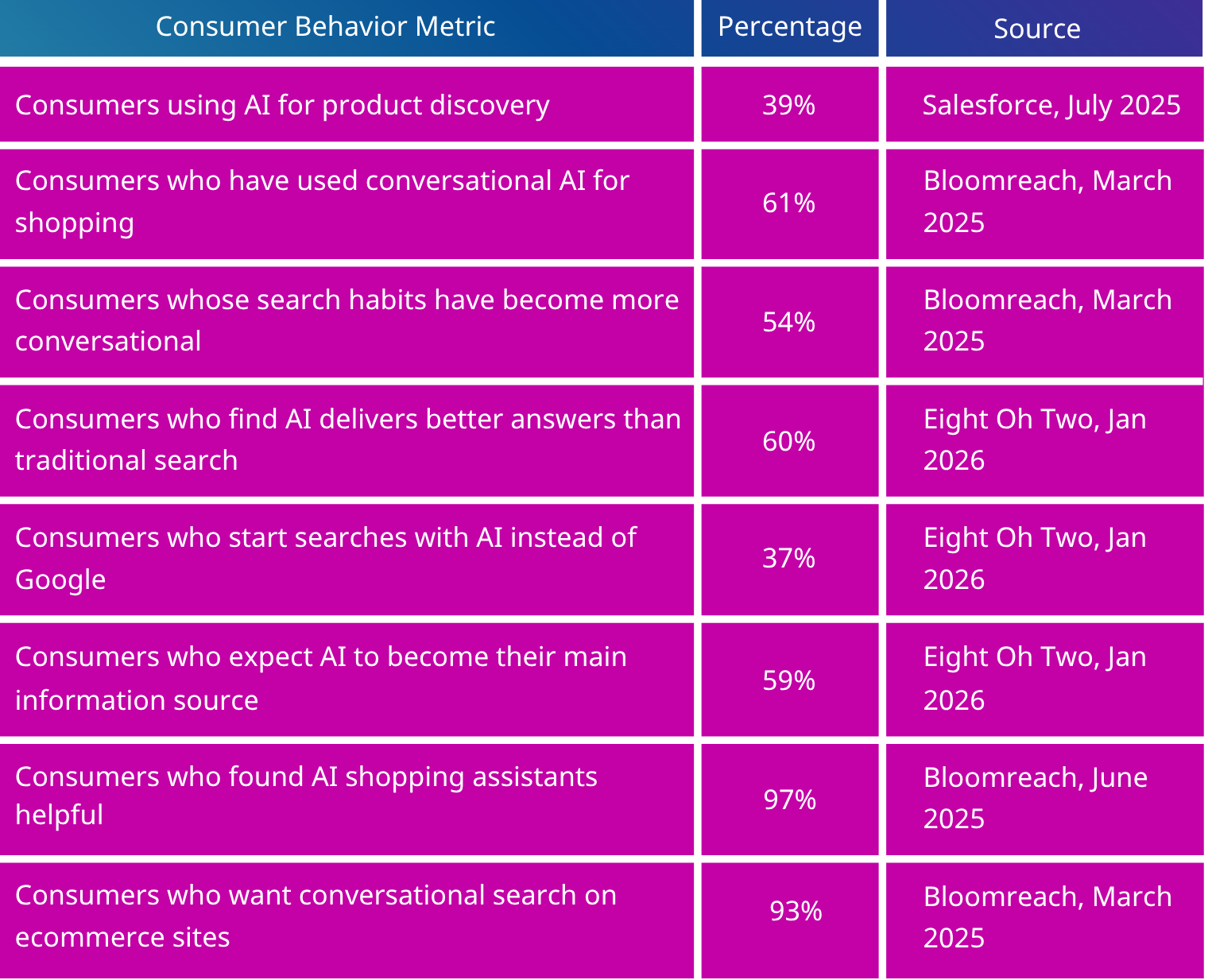
The Salesforce Connected Shoppers Report (July 2025) found that 39% of consumers — and over half of Gen Z — are already using AI for product discovery. A separate Capgemini survey found that nearly three in five consumers have begun replacing traditional search engines with generative AI, with two-thirds of millennials and Gen Z turning to tools like ChatGPT for product recommendations.
2.2 Consumer Demand for AI Search on Corporate Platforms
The most direct evidence of customer demand for AI-powered search on corporate platforms comes from Bloomreach's two major consumer research reports published in 2025. The first, released in March 2025, surveyed more than 1,000 U.S. consumers and found:
61% have used general-purpose AI tools like ChatGPT or Gemini to help them shop online
66% are at least somewhat familiar with AI shopping assistants built specifically for ecommerce
54% reported their search habits becoming more conversational over the past 12 months
35% said they search ecommerce sites using questions rather than keywords
93% said it is important that ecommerce site search understands conversational queries
The second Bloomreach report, released in June 2025, deepened these findings considerably. Among consumers who had used AI shopping assistants:
97% found them helpful
76.8% said these tools helped them decide to purchase items faster than shopping on their own
41.4% reported using natural language when searching
61.3% expressed interest in a conversational search bar on ecommerce sites
McKinsey's August 2025 AI Discovery Survey of 1,927 U.S. consumers found that half of consumers now intentionally seek out AI-powered search engines, with a majority of users saying it is their top digital source for making buying decisions — surpassing traditional search (31%), retailer or brand websites (9%), and review sites (6%). Notably, this adoption spans all age groups, including a majority of baby boomers.
Table 2: Consumer Behavior Metrics
2.3 Corporate Adoption: The Enterprise Response
The corporate response to this consumer demand has been rapid and broad-based, though the depth of implementation varies significantly by sector and company size. The most comprehensive picture comes from several major industry surveys conducted in 2024 and 2025.
Retail and Ecommerce: The NVIDIA "State of AI in Retail and CPG" survey (January 2025), drawing on hundreds of responses from industry professionals, found that 89% of retailers are either actively using AI in their operations or assessing AI projects — up from 82% in 2023. Among the top use cases for generative AI in retail, digital shopping assistants or copilots ranked fifth, cited by 40% of respondents, behind content generation for marketing (60%), predictive analytics (44%), personalized marketing (42%), and customer analysis (41%).
The BRG "AI in Retail" report (November 2025) found that AI is active in most core functions at nearly half (48%) of retailers, while 34% report it active in several functions. Amperity's 2025 State of AI in Retail report found that 45% of retailers already use AI daily or several times per week, and 97% plan to maintain or increase their AI investments in the coming year.
Broader Enterprise: McKinsey's 2025 Global Survey on AI found that 78% of organizations now use AI in at least one business function, up from 55% in 2023. The Deloitte State of AI in the Enterprise report found that worker access to AI rose by 50% in 2025, and the number of companies with 40% or more of their AI projects in production is set to double.
The enterprise AI search market itself has reached USD 7.47 billion in 2026 and is projected to grow to USD 11.66 billion by 2031, at a compound annual growth rate of 9.31%. The broader AI in ecommerce market is valued at $8.65 billion in 2025 and is projected to reach $17.1 billion by 2030.
2.4 The Business Case: Why Companies Are Making the Switch
The corporate decision to implement AI-powered conversational search is being driven by a convergence of customer demand signals and compelling performance data. The business case is built on three pillars: conversion rate improvement, average order value growth, and customer satisfaction gains.
Conversion Rate Improvement: Traditional keyword-based site search typically converts at 2–3%. Brands implementing AI-powered conversational search report conversion rates of 8–12% — a 3–4x improvement. This is consistent with McKinsey's finding that AI-driven discovery traffic, while lower in volume than traditional search traffic, converts at a significantly higher rate because consumers arrive at the right product having already been guided through a decision-making process.
Average Order Value: Context-aware AI recommendations and dynamic cross-selling capabilities drive average order values 25–50% higher than those achieved through traditional keyword search, according to analysis from Alhena AI.
Zero-Result Rate Elimination: Traditional site search tools fail to return any results for 10–15% of queries — a direct revenue loss. AI-powered conversational search reduces zero-result queries to near zero by interpreting intent rather than matching keywords.
Customer Satisfaction: Among consumers who have used AI shopping assistants, 97% report finding them helpful, and 76.8% say they made purchase decisions faster. Bloomreach's AI shopping assistant saw a 113% increase in messages sent on Black Friday 2025 versus the prior year, indicating rapidly accelerating consumer engagement.
Revenue Impact: Companies using AI personalization earn an estimated 40% more revenue, while AI chat functionality increases conversion rates by approximately 4x and helps shoppers complete purchases 47% faster.
2.5 The Decision Drivers: What Is Pushing Corporations to Act Now
Beyond the performance metrics, several structural forces are compelling corporate decision-makers to accelerate their AI search implementations.
The Expectation Transfer Effect. The most powerful driver is the behavioral conditioning effect of consumer AI tools. Consumers who use ChatGPT daily to get precise, conversational answers to complex questions arrive at corporate websites with a fundamentally different set of expectations than they held two years ago. They expect to be able to ask "What's the best brake pad for a 2019 Ford F-150 with heavy towing use?" and receive a specific, reasoned recommendation — not a list of 847 parts filtered by keyword. This expectation transfer is not a future trend; it is happening now, and companies that fail to meet it face measurable abandonment rates.
The Competitive Differentiation Window. McKinsey's analysis found that just 16% of brands today systematically track AI search performance. This creates a significant window of competitive advantage for early movers. Companies that implement AI-powered search now can capture market share from competitors still relying on keyword-based systems, particularly in sectors where product discovery is complex — automotive parts, industrial supplies, healthcare products, financial services, and specialty retail.
The Cost of Inaction. McKinsey projects that brands unprepared for the AI search transition may experience traffic declines of 20–50% from traditional search channels. Coveo's enterprise research found that 84% of technology professionals see search as a critical component of digital transformation, yet nearly 99% report they still face technical challenges with their current search implementations. The gap between the strategic importance of search and the adequacy of current solutions is the primary driver of enterprise AI search investment.
Customer Lifetime Value Implications. Salesforce's analysis found that AI-powered discovery traffic behaves differently from traditional search traffic: sessions are shorter but conversion rates are higher, and consumers who find what they need quickly through AI-guided discovery are more likely to return. This has direct implications for customer lifetime value and retention metrics.
2.6 Sector-Specific Adoption Patterns
The adoption of AI-powered conversational search is not uniform across industries. McKinsey's research found that 40–55% of consumers in top sectors — including consumer electronics, grocery, travel, wellness, apparel, beauty, and financial services — are already using AI-based search to make purchasing decisions.
In retail and ecommerce, the adoption curve is steepest. Amazon's launch of its Rufus AI shopping assistant in September 2024 was cited by 42% of Bloomreach survey respondents as the moment they became aware of AI shopping assistants, signaling that mainstream consumer awareness of in-platform AI search is now well established.
In B2B contexts — industrial supply, automotive parts, healthcare equipment, and enterprise software — the case for AI-powered search is arguably even stronger. B2B buyers routinely navigate catalogs of tens of thousands of SKUs, and the ability to ask a natural language question and receive a specific, contextually appropriate answer directly addresses one of the most persistent friction points in B2B commerce.
The Coveo enterprise search report found that 92% of organizations use search analytics to inform their business decisions, underscoring the centrality of search to enterprise operations even before the AI transition.
Part III: Synthesis and Outlook
3.1 The Integrated Picture
The two phenomena described in this report — the decline of traditional search engine usage and the rise of corporate AI-powered search — are not independent trends. They are two manifestations of the same underlying behavioral shift: consumers have learned that AI can answer their questions more directly, more conversationally, and with less friction than keyword-based search, and they are now applying this expectation universally — to public search engines and to corporate platforms alike.
The quantitative picture can be summarized as follows:
Table 3: Key Findings Summary
3.2 The Road Ahead
The trajectory of these trends suggests that the window for corporate action is narrow. McKinsey projects that $750 billion in U.S. revenue will funnel through AI-powered search by 2028. The companies that capture that revenue will be those that have built the infrastructure to meet consumers where they are — in a conversational, AI-guided discovery experience — rather than forcing them to navigate keyword-based interfaces designed for a pre-AI world.
For corporations in product-heavy sectors — automotive, industrial, healthcare, consumer electronics, and specialty retail — the imperative is particularly urgent. The auto parts customer who asks "What's the right alternator for a 2018 Chevy Silverado 5.3L?" does not want 847 search results. They want the answer. The companies that provide that answer, with the confidence and specificity of a knowledgeable sales associate, will earn the sale. Those that return a list of keyword-matched results will lose it — increasingly to competitors who have made the AI search investment.
The data is clear: the AI search revolution is not coming. It is here, it is accelerating, and the companies that recognize this shift and act decisively will define the next era of digital commerce.
References
This report was compiled from publicly available research, industry surveys, and analyst reports. All statistics are cited with their original sources. The current date of compilation is March 2026.
- SparkToro / Datos. "New Research: Google Search Grew 20%+ in 2024; receives ~373X more searches than ChatGPT." March 10, 2025. https://sparktoro.com/blog/new-research-google-search-grew-20-in-2024-receives-373x-more-searches-than-chatgpt/
- Search Engine Land / Graphite.io. "AI assistants now equal 56% of global search engine volume: Study." March 9, 2026. https://searchengineland.com/ai-assistants-global-search-engine-volume-study-471118
- Search Engine Land / Datos. "Google searches per U.S. user fell nearly 20% YoY: Report." January 28, 2026. https://searchengineland.com/google-searches-per-us-user-fall-report-468051
- Semrush. "29 Eye-Opening Google Search Statistics for 2025." July 9, 2025. https://www.semrush.com/blog/google-search-statistics/
- Digital Bloom. "2025 Organic Traffic Crisis: Zero-Click & AI Impact Report." October 30, 2025. https://thedigitalbloom.com/learn/2025-organic-traffic-crisis-analysis-report/
- Bain & Company. "Consumer reliance on AI search results signals new era of marketing." February 19, 2025. https://www.bain.com/about/media-center/press-releases/20252/consumer-reliance-on-ai-search-results-signals-new-era-of-marketing/
- The Guardian. "AI summaries cause 'devastating' drop in audiences, online news publishers say." July 24, 2025. https://www.theguardian.com/technology/2025/jul/24/ai-summaries-causing-devastating-drop-in-online-news-audiences-study-finds
- McKinsey & Company. "New front door to the internet: Winning in the age of AI search." October 16, 2025. https://www.mckinsey.com/capabilities/growth-marketing-and-sales/our-insights/new-front-door-to-the-internet-winning-in-the-age-of-ai-search
- Gartner. "Gartner Predicts Search Engine Volume Will Drop 25% by 2026, Due to AI Chatbots and Other Virtual Agents." February 19, 2024. https://www.gartner.com/en/newsroom/press-releases/2024-02-19-gartner-predicts-search-engine-volume-will-drop-25-percent-by-2026-due-to-ai-chatbots-and-other-virtual-agents
- OneLittleWeb / Growth Engines. "AI Search vs. Google: What the Next 5 Years of Traffic Really Look Like." January 13, 2026. https://growth-engines.com/insights/seo-aeo/ai-search-vs-google
- FatJoe. "Perplexity AI Stats Feb 2026: Uses, Users, Market Share, and More." February 20, 2026. https://fatjoe.com/blog/perplexity-ai-stats/
- LinkedIn / Hiran Wyatt. "Perplexity AI and the Struggles of Building Market Share." September 1, 2025.
- Ahrefs. "ChatGPT Has 12% of Google's Search Volume." February 11, 2026. https://ahrefs.com/blog/chatgpt-has-12-percent-of-googles-search-volume/
- SEOWorks. "How Many Searches Does ChatGPT Get Versus Google?" December 8, 2025. https://www.seoworks.co.uk/how-many-searches-chatgpt-versus-google/
- Search Engine Land / Eight Oh Two. "37% of consumers start searches with AI instead of Google: Study." January 7, 2026. https://searchengineland.com/consumers-start-searches-ai-not-google-study-467159
- Salesforce. "With AI Adoption Surging, Shopping Behavior Is at an Inflection Point." July 9, 2025. https://www.salesforce.com/news/stories/consumer-shopping-ai-trends-2025/
- Bloomreach. "More Than 60% of Consumers Have Used Conversational AI for Shopping." March 6, 2025. https://www.bloomreach.com/en/news/2025/bloomreach-announces-findings-from-conversational-ai-shopping-study/
- Bloomreach. "From Keywords to Conversations: New Research From Bloomreach Reveals How AI Is Teaching Online Consumers To Shop Like Humans Again." June 12, 2025. https://www.bloomreach.com/en/news/2025/bloomreach-releases-new-conversational-ai-report/
- NVIDIA. "9 Out of 10 Retailers Now Adopting or Piloting AI, Latest NVIDIA Survey Finds." January 10, 2025. https://blogs.nvidia.com/blog/ai-in-retail-cpg-survey-2025/
- BRG. "AI in Retail: In Pursuit of Meaningful AI Adoption." November 2025. https://www.thinkbrg.com/insights/publications/ai-in-retail-in-pursuit-of-meaningful-ai-adoption/
- Amperity. "AI in Retail: Today, Tomorrow, and Two Years from Now." January 20, 2026. https://amperity.com/blog/ai-in-retail
- McKinsey & Company. "The State of AI: Global Survey 2025." November 5, 2025. https://www.mckinsey.com/capabilities/quantumblack/our-insights/the-state-of-ai
- Deloitte. "The State of AI in the Enterprise — 2026 AI Report." 2026. https://www.deloitte.com/us/en/what-we-do/capabilities/applied-artificial-intelligence/content/state-of-ai-in-the-enterprise.html
- Mordor Intelligence / Yahoo Finance. "Enterprise Search Market — 9%+ CAGR Forecast for 2026–2031." March 6, 2026. https://finance.yahoo.com/news/enterprise-search-market-9-cagr-092600061.html
- ClickPost. "AI in eCommerce Statistics: Trends and Insights for 2025." February 7, 2026. https://www.clickpost.ai/blog/ai-in-ecommerce-statistics
- Alhena AI. "Conversational Search vs Traditional Search: Why ecommerce Discovery Needs AI." March 6, 2026. https://alhena.ai/blog/conversational-search-vs-traditional-search/
- Bloomreach. "Bloomreach AI Shopping Assistant Sees 113% Surge in Shopper Engagement on Black Friday." December 4, 2025. https://www.bloomreach.com/en/news/2025/bloomreach-ai-shopping-assistant-sees-113-surge-in-shopper-engagement/
- Coveo. "2023 Enterprise Tech Report on Search & AI." 2023. https://www.coveo.com/en/resources/reports/tech-survey-enterprise-search-ai