



If you manage a large Sitecore implementation, you have probably experienced this at some point:
- Hundreds or even thousands of old or stale pages
- Outdated messaging still indexed by Google
- SEO and AEO authority diluted by content that no longer reflects your brand
Your campaigns are optimized. Your dashboards look strong. But your content might be quietly working against you.
In this article, I will explore the stale content challenge, my initial single-agent approach, why I shifted to a hybrid model, and how this pattern can extend to other marketing use cases.
The Real Problem: Stale Content Can Impact Authority
When content on your website becomes outdated and no longer reflects your current brand tone or strategy, it can quietly weaken your messaging and impact both SEO and AEO performance.
At first glance, the fix seems simple. Just use the created or last updated date to flag older items for review. In some cases, that works. But it is not always that straightforward. For example:
- Content migration has impacted the create and update dates of items.
- Content created long ago may still align with your current brand tone and strategy.
So the real question was not:
When was this created?
It was:
Does this content still represent who we are today?
That is not something a date field can answer. It requires interpretation. It requires context. And that is where AI becomes incredibly valuable.
The Original Plan: One Agent to Do It All
My initial idea was straightforward. Build a single agent inside SitecoreAI that would:
- Analyze all pages
- Determine whether content is stale
- Evaluate brand tone and alignment
- Generate a marketer-friendly archive report
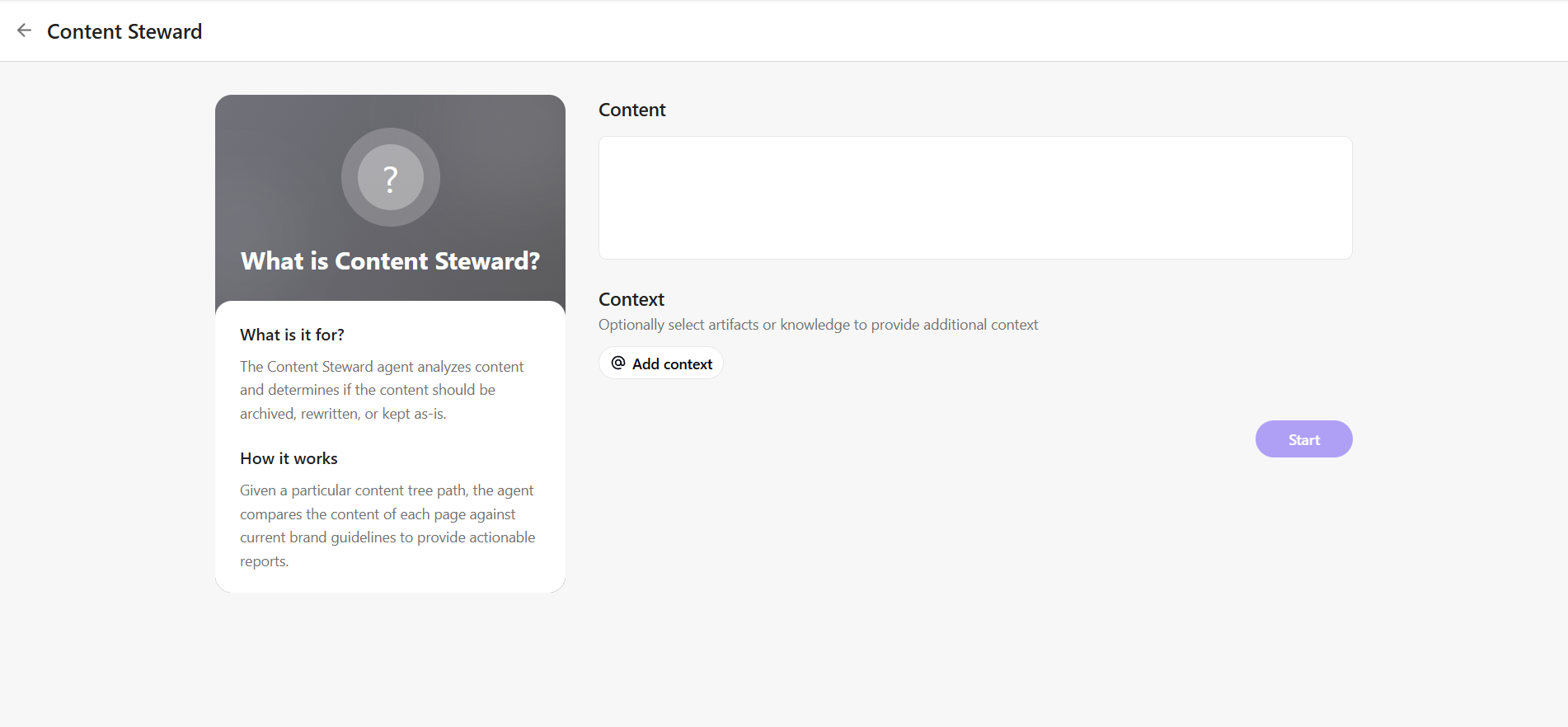
In theory, this would allow marketers to run a single process, review recommendations, and confidently archive outdated content.
It was clean. It was simple. And it highlighted how powerful AI inside the CMS can be.
As I began implementing it, I also discovered areas where the platform has clear opportunities to mature.
Opportunity #1: Expanding Deterministic Content Retrieval
Sitecore AI agents are not completely isolated from the CMS.
They can leverage the Marketer MCP to fetch item details, which is a meaningful step forward. This allows an agent to retrieve structured content information rather than relying purely on pasted text.
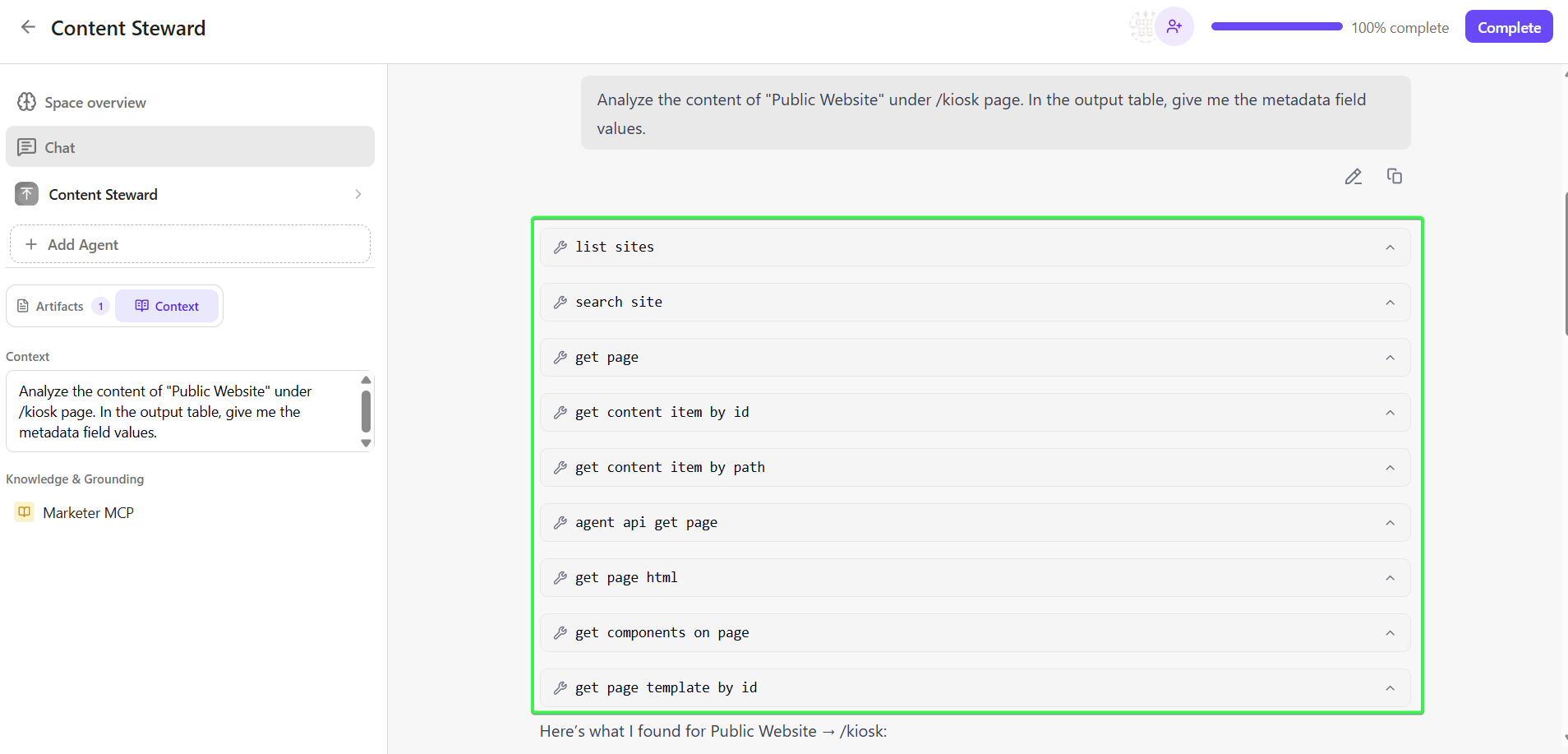
That is powerful.
However, today this interaction is not as deterministic as running a full item query by path, template, or structured GraphQL query.
For example, while an agent can request item details, it does not yet operate like a developer-driven query that says:
“Give me every item under /blog using Template X where Field Y contains Z.”
That level of precision still lives in traditional APIs. From a maturity standpoint, this opens an exciting opportunity.
Opportunity #2: Enabling External API Calls
Another natural area for evolution is support for more generic external API calls directly from within agents.
Today, agents are primarily focused on analysis. If future iterations allow them to:
- Execute structured internal queries
- Call external APIs
- Interact with third-party systems
That level of orchestration would significantly expand the impact of AI inside Sitecore.
The Pivot: Marketplace App Plus AI Agent
Instead of trying to force the agent to handle everything, I separated responsibilities.
The orchestration moved outside the agent. The updated approach looks like this:
- A marketplace app initiates the process
- The app uses Sitecore APIs to retrieve content
- Metadata and structure are evaluated programmatically
- The content is sent into a Sitecore AI agent for qualitative analysis
- The agent returns structured recommendations
- The app generates a marketer-ready report
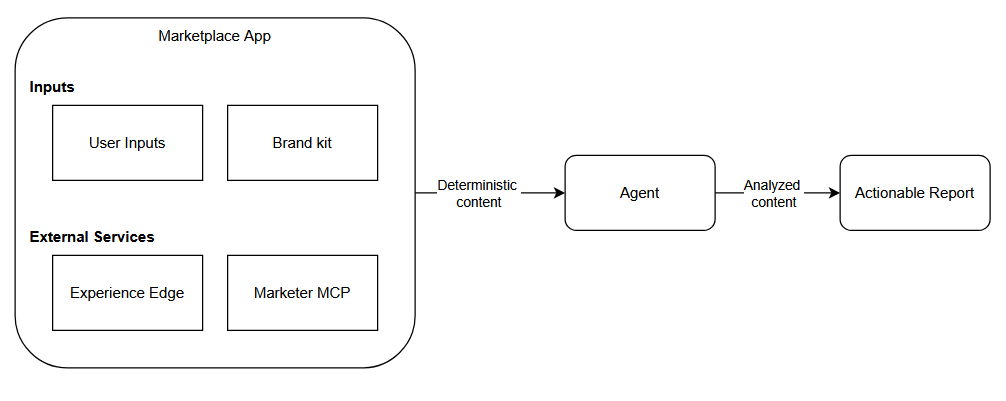
This approach combines structured CMS access with AI-powered interpretation.
The agent focuses on analysis. The app handles retrieval, orchestration, and reporting.
It is a practical solution today, and it still leverages the strengths of SitecoreAI.
What Marketers Actually See
Instead of raw AI responses, the final output is clear and actionable:
| Page | Brand Alignment | Staleness Score | Recommended Action | Confidence |
|---|---|---|---|---|
| /blog/2019-strategy | Low | High | Archive | 92% |
| /product/legacy-plan | Medium | Medium | Rewrite | 78% |
| /insights/market-trends | High | Low | Keep | 89% |
The result is a scalable content governance process rather than a one-time cleanup effort.
Looking Ahead
One area I am still evaluating is whether custom SitecoreAI agents can be invoked directly through an API.
If agent invocation becomes available programmatically, it would simplify this architecture significantly and unlock new automation scenarios. If not, we can still replicate prompt logic externally or leverage other model APIs.
I will have a follow-up article on the final implementation with further insights.
Final Thoughts for Marketers
AI inside Sitecore is not just about generating copy.
It is about:
- Governance at scale
- Protecting brand integrity
- Strengthening SEO and AEO performance
- Making better decisions faster
Stale content is inevitable in growing organizations. Allowing it to dilute your authority and brand is optional.
When you treat AI agents as strategic assistants and combine them with smart orchestration, you create a system that continuously improves your content ecosystem. This approach can be used to tackle a wide variety of marketer challenges.