



I recently joined a group of marketing and technology leaders to discuss something that's been reshaping our industry in real time: the evolution of web personalization. What struck me most wasn’t that personalization has gone through multiple transformations but just how far we have come, and how quickly the next frontier is arriving.
Over the last 20+ years, personalization has evolved from simple rule-based targeting powered by cookies to real-time, AI-driven, conversational experiences powered by unified customer data, machine learning, and generative AI. Each wave has fundamentally changed how brands engage with customers and how marketers think about digital experiences. We are now firmly in the era of Personalization 4.0. To appreciate what that means, it helps to understand the journey that got us here.
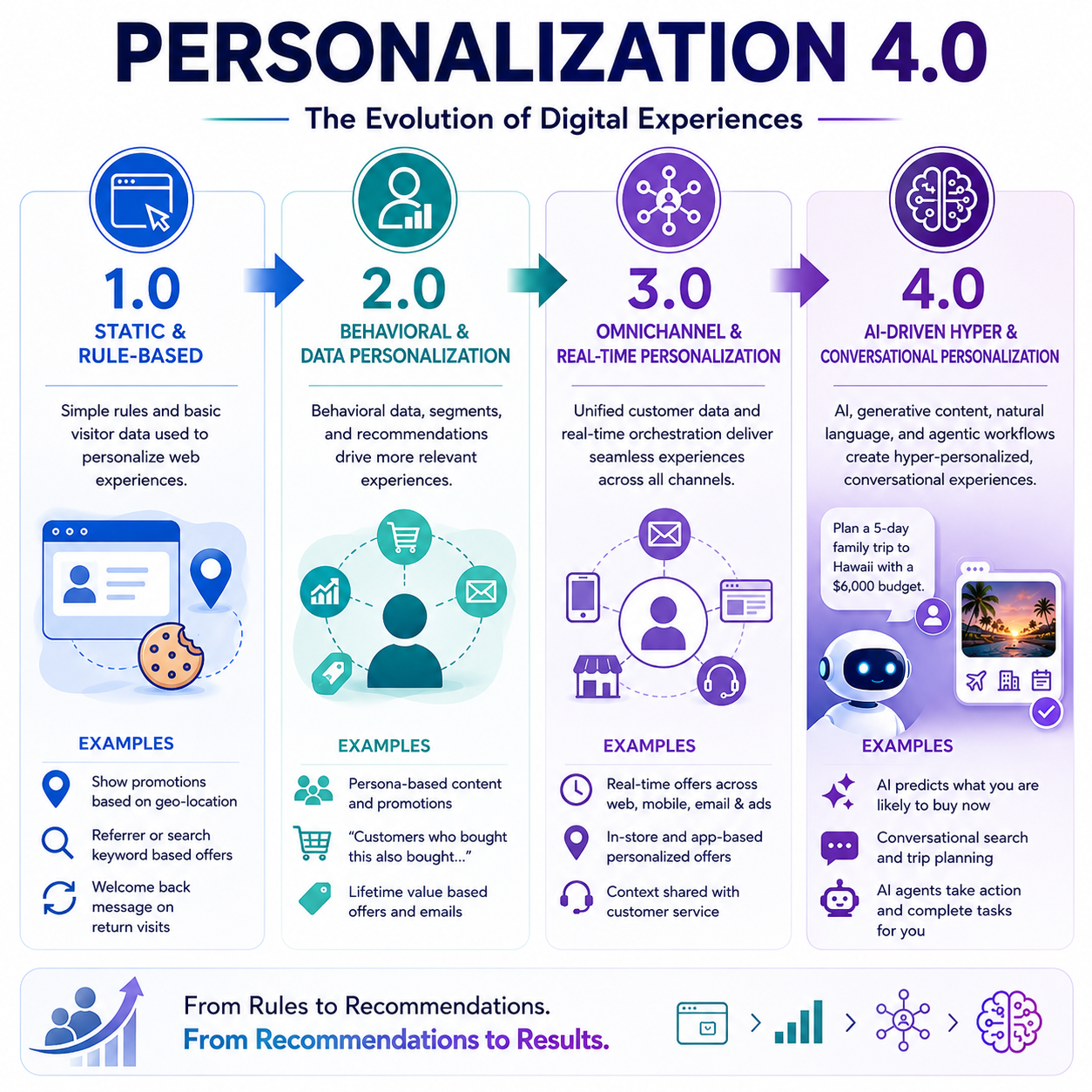
Personalization 1.0: The Rule-Based Era
The early promise of web personalization was simple: use what you know about a visitor to show them something relevant. Cookie data, IP geolocation, referral sources — these were the building blocks.
If a visitor was browsing a travel website from California, show a Hawaii vacation promotion. If they were browsing from Illinois, show a Florida vacation promotion. If a visitor arrived from a Google search for "sunny beach vacations," display beach vacation offers. If a visitor was returning to a specific page for the third time, show a "Welcome Back" message or a special discount.
It was blunt by today's standards, but it was a revelation at the time. A/B testing gave marketers a feedback loop they'd never had before. The web became a canvas for experimentation, and personalization became a discipline.
Personalization 2.0: Behavior and Data Take the Wheel
Amazon and Netflix didn't just build great recommendation engines — they redefined customer expectations. Suddenly, static rules felt inadequate. Marketers began investing seriously in behavioral data, customer segmentation, and pattern recognition.
Persona-based targeting emerged: identify a visitor as a "Family Vacationer" profile and serve content tailored to that profile. Market basket analysis such as "Customers who booked a Hawaii vacation also booked the Kīlauea excursion package" unlocked cross-sell logic at scale. Customer lifetime value moved from a finance metric to a marketing lever.
The focus shifted from "Who is this visitor?" to "What does this visitor's behavior tell us about their interests and intent?" Data became a strategic asset, and the teams that knew how to use it pulled ahead.
Personalization 3.0: The CDP Era and the Promise of Real-Time & Omnichannel
The 3.0 wave was driven by Customer Data Platforms (CDPs), Customer 360 initiatives, cloud data platforms, event streaming technologies, and machine learning. Organizations worked to unify customer identities across channels and orchestrate seamless experiences across web, mobile, email, social media, in-store interactions, and customer service.
A user who browsed vacation packages on their phone at lunch could receive a personalized email by afternoon, see a retargeted ad on social media by evening, and be greeted with a matched offer on the desktop site that night.
The goal was consistency and continuity — a brand experience that followed the customer intelligently, wherever they went. This era marked the transition from personalized campaigns to personalized customer journeys.
Personalization 4.0: Hyper-Personalization Meets Generative AI
This is where the real inflection point lies — and why the conversations happening in boardrooms and marketing summits right now feel genuinely different from those of any prior era. Personalization 4.0 is defined by the convergence of large language models, generative AI, unified customer intent data, and agentic automation. The shift is not incremental. It is architectural.
From Segments to Individuals
The old model selected the best pre-built content for a user. The new model generates content tailored to that specific person in that specific moment.
Two users visiting the same vacation package page might see entirely different imagery, copy, and offers — one optimized around adventure, another around relaxation — because the AI has predicted which framing is most likely to drive engagement for each.
From Search to Conversation
Instead of filtering through options, users can simply express intent:
"Plan a five-day family trip to Hawaii on a $6,000 budget."
The system doesn't retrieve results — it constructs a personalized itinerary, complete with flights, accommodations, activities, dining, and a budget breakdown. The interface becomes a dialogue, not a directory.
From Recommendation to Action
This is the frontier that most excites me. The next wave isn't about what the system suggests — it's about what the system does.
A user who says, "Book the best option using my loyalty points," isn't asking for recommendations. They're delegating. The system knows their preferences, accesses their accounts, searches and compares in real time, and completes the transaction. Personalization becomes agency.
What This Means for Leaders
The brands that will win in this era are not simply those with the most data; they're the ones that can activate it intelligently, in real time, across every touchpoint, in service of experiences that feel genuinely individual.
The future of personalization is no longer about showing users the right experience; it is about helping them achieve the right outcome. That requires rethinking technology stacks, talent, governance, and trust.
Personalization 4.0 is here.
The opportunity is extraordinary.
So is the responsibility.